Compare casting and forging—in terms of part strength, prevention of defects, reliability of production, response to heat treatment, and adaptation to production demand. See how forging ultimately leads to a more desirable product when compared against the results of casting.
Strength
- Casting: Casting cannot obtain the strengthening effects of hot and cold working.
- Forging: Whether open or closed die forging is used, the forging process surpasses casting in predictable strength properties. Forging produces superior strength that is assured, part to part. In other words, forgings are stronger than castings.
Prevention of Defects Through Pre-Working
- Casting: A casting has neither grain flow nor directional strength. Additionally, the casting process cannot prevent formation of certain metallurgical defects.
- Forging: Pre-working forge stock produces a grain flow oriented in directions requiring maximum strength. Dendritic structures, alloy segregations, and similar imperfections are refined in forging.

Reliability of Production
- Casting: Defects occur in a variety of forms through the casting process. This means tight process controls and inspections are needed to ensure a reliable final product.
- Forging: Hot forging refines grain pattern and imparts high strength, ductility, and resistance properties. As a result, forged products are both more reliable and free of the added costs for tighter process controls and inspection that are required for casting.
Response to Heat Treatment
- Casting: Castings require close control of melting and cooling processes because alloy segregation may occur. This results in non-uniform heat-treatment response that can affect the straightness of finished parts.
- Forging: Forgings respond more predictably to heat treatment than castings. They also offer better dimensional stability.
Flexibility of Production to Demand
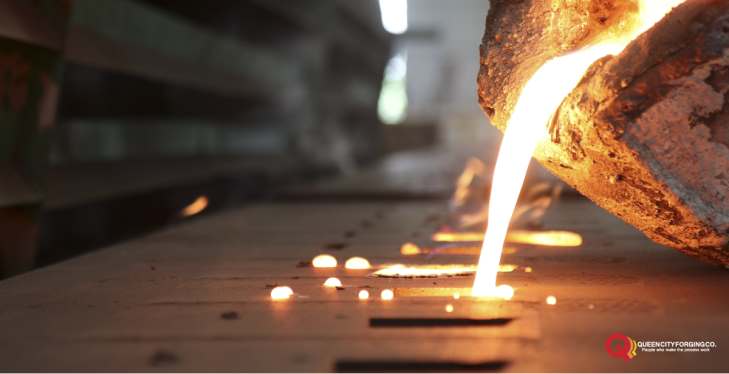
- Casting: Some castings, such as special performance castings, require expensive materials and process controls—plus longer lead times.
- Forging: Open die forging processes adapt to various production run lengths and enable shortened lead times.
As you can see, the forging process produces a superior product to casting in terms of strength, reliability, and other factors. For more information about forging vs. casting, view our blog post, Is it Forging, Casting, or Something Else?