Compare welding and forging in terms of cost, strength, design, metallurgical properties, inspection requirements, and production. See how forgings are superior in quality to weldments and fabrications.
Production Economies & Material Savings
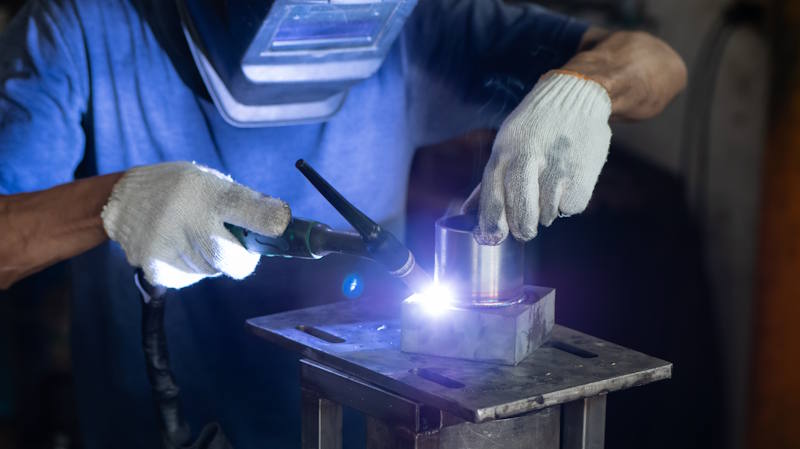
- Welding: Welded fabrications are more costly in high volume production runs. In fact, fabricated parts are a traditional source of forging conversions as production volume increases.
- Forging: Initial tooling costs for forging can be absorbed by production volume and material savings. Forging also has lower labor costs, scrap and rework reductions, and reduced inspection costs compared to welding.
Strength
- Welding: Welded structures are typically not free of porosity. Any strength benefit gained from welding or fastening standard rolled products can be lost by poor welding or joining practice.
- Forging: The grain orientation achieved in forging makes stronger parts than welding. Due to their strength, forged parts can function in harsher conditions.
Cost-Effectiveness of Design
- Welding: A multiple-component welded assembly cannot match the cost-savings gained from a properly designed, one-piece forging.
- Forging: The part consolidation inherent in one-piece forgings can result in considerable cost savings.
Metallurgical Properties
- Welding: Selective heating and non-uniform cooling that occur in welding can yield undesirable metallurgical properties. In use, a welded seam may act as a metallurgical notch that can lead to part failure— even in hard materials, but especially in softer metals like brass and aluminum.
- Forging: Unlike welding, forging produces no internal voids that cause unexpected failure under stress or impact. The consistency of their metallurgical properties keeps forged parts sturdy.
Inspection Requirements
- Welding: Weldments require costly inspection procedures, especially for highly stressed components.
- Forging: Forgings are not subject to the defects weldments have. As a result, forging does not require the same costly and time-consuming inspection processes.
Production
- Welding: Welding and mechanical fastening require careful selection of joining materials, fastening types and sizes – plus close monitoring of tightening practice. All of this increases production costs.
- Forging: Forging simplifies production and ensures better quality and consistency than welding— part after part.