


Which Design Process Fits Your Needs?
Impression Die Forging
The impression die forging process is best for larger quantities of more complex shapes. This process produces forging configurations near-net or net to finish requirements.
More demanding metallurgical requirements often require deformation energy through complex cross sections of a component. To develop the toughness, impact strength and fatigue properties demanded by the service performance, an impression die forging may be the best solution and one that only truly wrought products can provide.
As demands for product performance require more expensive alloys, the benefit of impression die tooling increases. Impression die forgings can improve yield by requiring less input material and less machining to achieve the end product.
Open Die Forging
When smaller quantities of rough shaped pieces are required, the open die forging process is able to provide the requirement with simple, stock tooling. These include lengths of a forged bar, relatively simple blocks, disc shapes or configurations that do not have significant complexity.
Consider the quantities and shapes a blacksmith might make by hand. Then, add the ability to also make much larger forgings. Requirements for open die can go from “hand” forged items to massive forgings that weigh many tons. Massive forgings require manipulators comparable in size to railroad locomotives.
The open die forging process is also frequently used for small quantities of ring shapes with the “saddle/mandrel” method. This method shapes the ring in small steps.
Rolled Ring Forging
When a ring shape larger than about six inches in inner diameter is required, the rolled ring forging process will likely be the best option. When larger volumes of ring shapes are required, the ring rolling process twill be the most cost-effective means to produce ring shapes of most sizes. Ring rolling machines can produce precise dimensional control compared to open die saddle/mandrel machining operations. Rolling machines can often produce contoured inner diameter (ID) and outer diameter (OD) configurations.
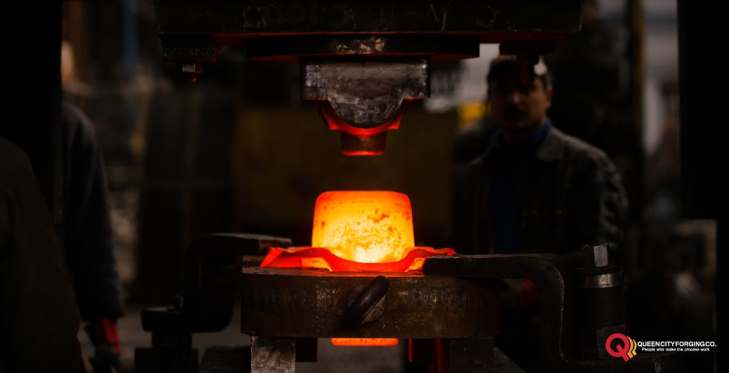
Rolled ring forging begins with an open die process, hot punching a hole into a press formed disk to create the preform “donut” for the ring rolling machine. The rolling process forms and stretches the blank, adding the critical deformation energy. This energy refines the metallurgical structure, assuring true wrought properties.
Forging Design Costs
Impression Die Costs
With impression die forging, tooling costs vary significantly depending upon the:
- Complexity of the configuration
- Volume of forgings required
- Type of material selected
Impression die forgings typically require less machining and are closer to net shape. Some require minimal additional machining, with “as forged” finish left on the completed component.
If the heat-treated condition is machinable, the forging may be converted directly to a finished part, no additional heat treatment required. Items such as gear teeth or other wear surfaces may require surface hardening but the core forging is usually heat treated to provide the strong, tough base material of the component.
Open Die Costs
In most cases, the open die forging process requires relatively simple tooling. The process will typically provide a larger forging “envelope” around the finished part dimensions, requiring rough machining and, possibly, several finishing steps. Additional heat treatment may be required to achieve material properties throughout the cross section of a finished part after initial machining operations. Open die forging generates a significant volume of turnings and machining chips.
Rolled Ring Costs
Tooling is often only required for special OD and/or ID contours on a rolled ring. Heat treatment performed on the forged ring may be sufficient as rolled ring forgings are often in near net form. Residual stresses in large rings can be a challenge that requires additional thermal/machining steps. These extra steps assure dimensional stability, but rings are often machined in the as forged condition, then heat treated to the final product.
Added Benefits of Forging
Unlike most polymers and composite materials, machining chips, turnings, bar drops, scrap and even forgings can and will eventually be recycled into the materials market to be reused. Conservation of resources is assured using metal alloys that can be recycled and reused, again and again.
The fully dense, consistent metallurgical structure of forgings guarantees consistent, smooth machined surfaces. Hard spots, porosity, tear outs, or other defects often experienced with other metal working processes during machining are simply not an issue with forged product.
Forged surfaces are readily prepared to accept coatings, plating, anodizing, and other high finishes, providing an excellent, uniform appearance with maximum resistance to corrosion or failure of coating adhesion.
Forging provides true wrought properties by building confidence that ultimate performance is guaranteed.
Requirements of True Wrought Properties
Strength
The mechanical property requirements for Yield Strength (Yield), Ultimate Tensile Strength (UTS), Elongation and Reduction of Area (ROA) should be calculated for any design using computational analysis. A safety factor multiple over model predictions is needed to account for shock/momentary loading. Wrought properties provided by forging provide ultimate strength for almost every alloy.

Durability
Impact toughness provides the safeguard against shock/momentary loading during in-service conditions with both frequent cycling and continuous loads. The thermomechanical process of forging drives recrystallization of fine-grained, consistent microstructure, metallurgy that provides the highest resistance to fatigue failure of component parts.
Corrosion Resistance
Forgings provide best results for alloys designed to use in corrosive environments. Achieving 100% density of fine-grained microstructure, crushing voids and dispersing any remaining inclusions, forgings provide fewer pathways for chemical attack compared to competing metal working processes.
Heat Resistance
Refractory metal alloys – those that will yield to thermomechanical deformation – achieve metallurgy that survives longer and stronger than other means of production. They may be tough to forge but produce even tougher end products. Components constructed using other methods can form preferential fissures and weak spots, which lead to premature and unplanned failures.
Conductivity
Alloys designed for thermal, magnetic, or electrical conductivity – such as copper, aluminum, and silicon/core iron – can gain improved conductivity or magnetic permeability from the forging process. This is due to assurance of full density and microstructure that can only be achieved with thermomechanical processing. These materials perform efficiently and effectively because of optimum metallurgy when engineering the forging process design.
Filed under: Forging Benefits, Top Forging Questions, Types of Forging