

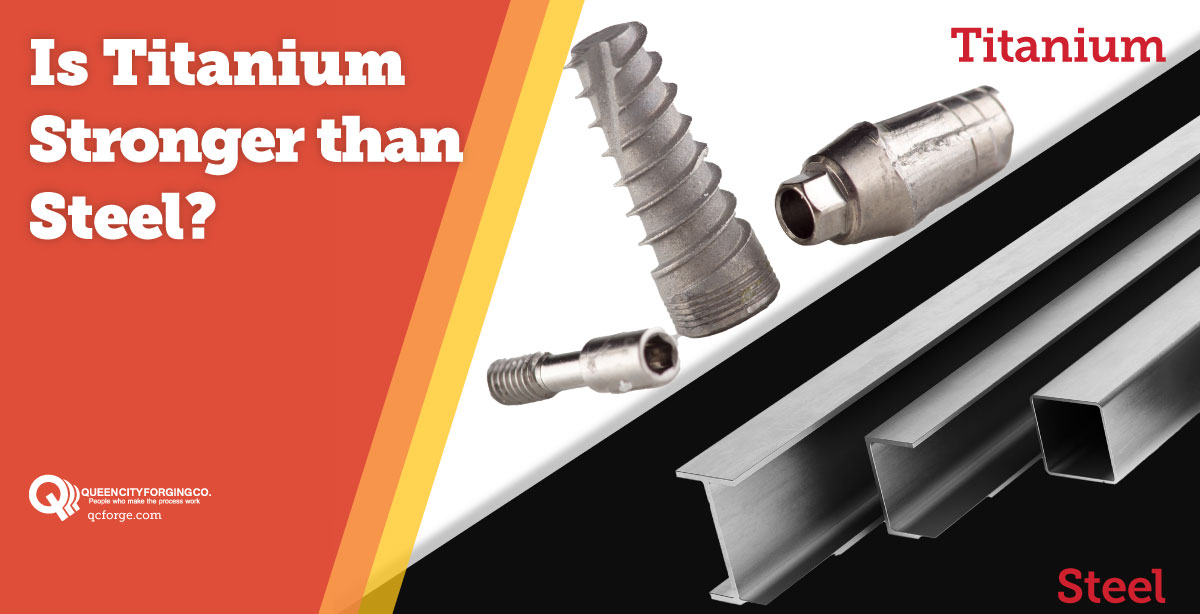
In the world of materials engineering, a common question is whether titanium is stronger than steel. Both metals have unique properties that make them suitable for various applications. Below, we’ll provide a comprehensive comparison, focusing on their strengths and applications.
Titanium vs. steel strength at a glance:
- Tensile strength: Steel
- Yield strength: Steel
- Hardness: Steel
- Strength-to-weight ratio: Titanium
- Corrosion resistance: Titanium
Understanding Strength
Strength in materials can mean different things, including:
- How much a material can be pulled or bent before it breaks (ultimate tensile strength)
- How much force is required to cause a material to stretch or bend beyond rebound recovery (yield strength)
- Resistance to wear, scratching or galling (hardness)
We’ll look at a few types of strength to compare titanium and steel. It’s essential to define what type of strength we are discussing when evaluating which metal is stronger.
Ultimate Tensile Strength
Ultimate tensile strength is how much a material can be pulled or bent before it breaks. Titanium alloys, such as Ti-6Al-4V, have a tensile strength of around 1000 MPa. In comparison, high-strength steels, like AISI 4340, can reach tensile strengths of up to 1400 MPa. Therefore, in terms of tensile strength, while titanium is strong, certain steel alloys are stronger.

Yield Strength
Yield strength is the point where a material starts to bend or stretch and doesn’t go back to its original shape. Titanium alloys typically have a yield strength of about 800 MPa, while high-strength steels can have yield strengths exceeding 1200 MPa. Again, in many cases, steel demonstrates higher yield strength than titanium.
Hardness
Hardness measures a material’s resistance to deformation, particularly permanent deformation, scratching, cutting, or abrasion. Steel generally exhibits higher hardness compared to titanium, making it more resistant to wear and tear.
Weight and Density
Titanium’s most significant advantage is its low density. Titanium is about 45% lighter than steel, which makes it an excellent choice for applications where weight reduction is crucial, such as in aerospace and automotive industries.
Corrosion Resistance
Titanium is renowned for its exceptional corrosion resistance, especially in harsh environments. This property makes it ideal for applications in marine, chemical processing, and medical industries. While stainless steels also offer good corrosion resistance, titanium often outperforms them in more aggressive environments.

Applications
Titanium
Due to its high strength-to-weight ratio and corrosion resistance, titanium is widely used in:
- Aerospace components
- Medical implants
- Marine applications
Steel
With its superior tensile and yield strength, steel is preferred in industries such as:
- Construction
- Automotive
- Heavy machinery
Choosing the Right Alloy
While steel generally exhibits higher tensile and yield strength compared to titanium, the choice between these materials depends on the specific application requirements. Titanium’s lightweight and corrosion-resistant properties make it invaluable in industries where these characteristics are critical.
At Queen City Forging, we understand the importance of selecting the right material for the job and are here to help you make informed decisions.
For more insights into material properties and their applications, stay tuned to our blog.
If you have any questions or need assistance with your projects, feel free to contact Queen City Forging.
Filed under: Forging Materials, Top Forging Questions